
QNAP NAS boxes running Plex: attackers are getting in through Plex2Shell
 9 November 2026
QNAP says some customers' NAS boxes appear to have been compromised through Plex2Shell, four chained flaws in Plex Media Server. If you run Plex on a NAS or any other computer, update it to 1.43.3.10861 or later, and if it was reachable from the internet, treat the box as possibly compromised.
What happened
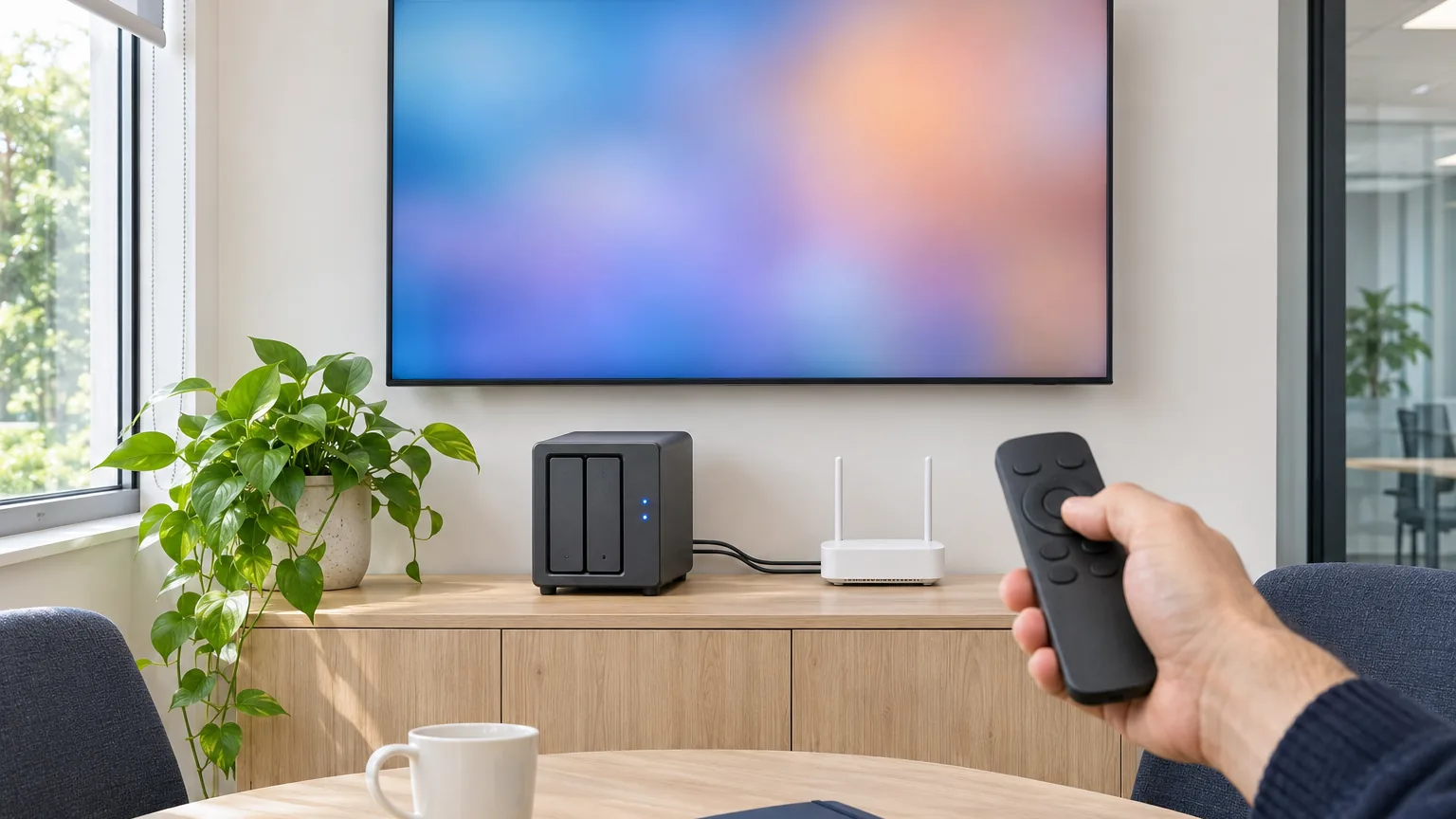
QNAP says some customers report that Plex Media Server on their NAS appears to have been compromised through "Plex2Shell", four flaws in the Plex app. Chained together they let an attacker run their own code on the box without logging in. QNAP's own NAS software is not affected, and QNAP's support team says it "has confirmed that no data loss has occurred" for the customers it is helping.
Plex fixed the flaws in Plex Media Server 1.43.3.10861, out since 04/08/2026. Plex says a public proof of concept appeared on 16/10/2026 and that since then it has seen "widespread attacks against internet-facing servers that haven't been updated", which were then used to run cryptocurrency miners and proxy software.
Does this affect you
You are in scope if anyone in the business runs Plex Media Server older than 1.43.3.10861. That is not only QNAP: Plex gives update steps for Windows, Mac, Linux, Docker and NAS boxes, and Synology issued its own fix on 08/11/2026. A NAS or computer without Plex needs no action.
A box showing "1.43.3" is not proof. Censys says earlier 1.43.3 builds, including 1.43.3.10828, are still affected. Check the full number in Plex Web, under Settings, then General.
What to do
- Ask whoever looks after the NAS or server: "Do we run Plex anywhere, and what is the full version number?"
- Update it today. On a QNAP, use App Center, My Apps, Plex Media Server, Update. On a Synology, update the Plex package to 1.43.5.11079 or later. Plex only updates itself on Windows and Mac, and only if automatic updates are on.
- If Plex could be reached from the internet while it was on an older version, or you only updated after 16/10/2026, QNAP and Plex say updating is not enough: treat the box as possibly compromised. Reachable means Plex Remote Access was on, port 32400 was forwarded, UPnP opened it, or myQNAPcloud's router setup exposed it.
- In that case, follow QNAP's FAQ (or Plex's post on other systems): keep a copy of the Plex Logs folder if you want the vendor's help, reinstall Plex cleanly without reusing its old Codecs folder, then check for the signs below.
- Sign out of all devices in your Plex account first, then change the Plex password. QNAP says a new password alone is not enough, because the owner's admin token may have been stolen.
- Change the NAS admin and user passwords, turn on two-step verification, and change any passwords or keys stored on the NAS for backup jobs and cloud connections.
- If nobody needs Plex from outside, switch off Remote Access in Plex, remove any port 32400 forwarding on the router, and turn off UPnP. If you do need it, QNAP says to use a VPN instead.
Is it being attacked?
Yes. Plex says the flaws "are being actively and widely exploited". A honeypot operator saw the first attacks on 17/10/2026, the day after the proof of concept, according to Censys. CISA added all four flaws to its list of exploited flaws on 20/10/2026, and its federal deadlines (23/10 and 03/11/2026) have passed.
Found by
All four CVE records credit Zach Main. His own write-up has a section headed "How I found it with LLMs" and says "I used LLMs heavily for all 4 parts", while "All of the judgment calls on what to look for and what to prioritize were mine." So the tag is people using Ai.
For developers
- CVE-2026-96652, SSRF via
/player/timelinewith anyX-Plex-Tokenvalue (CWE-918; CVSS 3.1 4.3, CVSS 4.0 5.3). - CVE-2026-96654, URL injection in
searchOnethat lets an attacker call other plugins' functions (CWE-84; CVSS 3.1 6.5, CVSS 4.0 6.9). Plex describes it as "Access to internal agent functions over the loopback interface". - CVE-2026-96655, SSRF to arbitrary hosts via
/video/:/transcode/universalfor an authenticated user (CWE-918; CVSS 3.1 4.3, CVSS 4.0 5.3). Plex describes it as "Disclosure of the server owner's admin token". - CVE-2026-96656, arbitrary file write by an admin user through
TranscoderH264Options; at startup "all .so files are run without signature, execute bit, or symbol checks" (CWE-73; CVSS 3.1 7.2, CVSS 4.0 8.6). - CNA: CISA. Published 23/09/2026. Affected: Plex Media Server below 1.43.3.10861; 1.43.3.10861 unaffected. Latest Plex release 1.43.5.11079 (23/10/2026).
- QNAP: "Each presents limited risk on its own, but chained together they allow an unauthenticated remote attacker to execute arbitrary code with the privileges of the Plex Media Server process."
- Signs of compromise (Plex and QNAP): processes started by Plex named
myawesomeproxy,mylovelyminerorx12345; unfamiliar.soor.dllfiles in the Codecs folder; outbound connections toproxystream.st; sustained high CPU while nothing is playing; on QNAP, a Malware Remover detection such as MR2104. QNAP: "do not just remove the suspicious program; other components or persistence mechanisms may remain." - Plex: "Treat anything the Plex service account could reach as potentially exposed, such as mounted shares and credentials stored on the same machine or VM." Rebuild from a clean installation "rather than reusing the old Plex data directory".
- Censys (20/10/2026): about 324,000 hosts run Plex Media Server, about 30 percent a vulnerable build, and nearly 8,000 run an early 1.43.3 build "most likely to be mistaken for patched".
- Synology-SA-26:17: fixed in 1.43.5.11079-720011079 (DSM 7.4 and 7.3) and 1.43.5.11079-700011079 (DSM 7.2.2 and 7.2.1); mitigation "None".
- KEV (catalogue 2026.11.06): all four added 20/10/2026; due 23/10/2026 for 96654 and 96656, 03/11/2026 for 96652 and 96655; known ransomware use Unknown.
- Disclosure (Zach Main): reported to Plex 27/07/2026, bounty paid 04/08/2026, CVEs 23/09/2026, public 16/10/2026.
- UK: no NCSC item. For a live attack the NCSC says to call 0300 123 2040 (24 hours a day); for personal data, the ICO says a likely risk must be reported "where feasible within 72 hours".
Sources
- QNAP security notice, Plex2Shell, 06/11/2026
- QNAP FAQ, Plex2Shell check and remediation, 06/11/2026
- Plex, Important Security Update for Plex Media Server v1.43.2 and earlier, 19/10/2026
- Synology-SA-26:17, 08/11/2026
- CVE.org, CVE-2026-96656, 23/09/2026
- CVE.org, CVE-2026-96652, 23/09/2026
- Zach Main, Plex2Shell, 16/10/2026
- Censys, Plex2Shell advisory, 20/10/2026
- CISA KEV JSON catalogue 2026.11.06
- NCSC, small business guide: response and recovery
- ICO, personal data breaches
Read next
More from The Patch Wave
- Act today

iPhones, iPads and Macs: update today, Apple has patched a compression flaw already on the US exploited list
Apple's 09/11/2026 updates fix the Brotli flaw CVE-2026-111497, which CISA added to its exploited list on 27/10/2026, and an iMessage group chat flaw. Update iPhones, iPads and Macs today.
- Act today
Microsoft Outlook: November's updates fix a flaw attackers are already using
Microsoft says attackers are already using an Outlook flaw (CVE-2026-124194) fixed in this month's updates. Update Office and run Windows Update today.
- Watch

Hotmail and Outlook.com bounced some business email for nearly three days: Microsoft has fixed it
Microsoft says a faulty spam rule update made Outlook.com, Hotmail and Live wrongly block some email from 06/11 to 09/11/2026. It has rolled the update back. If your mail to those addresses still bounces, tell your IT person.